The History of the I Ching
Find out how the world's oldest oracle evolved
By Paul O'Brien
The Chinese I Ching, or Book of Changes in English, represents sixty-four archetypes that make up all the possible six-line combinations of yin and yang, called hexagrams. Yin/yang is the fundamental duality of the Universe whose dynamic tension gives shape to all phenomena and the changes they go through. Examples of the yin/yang polarity are female/male, earth/heavens, dark/light, in/out, even/odd, and so on. The interpretations of the sixty-four hexagrams describe the energy of human life divided into sixty-four types of situations, relationships or dilemmas. Each hexagram can be analyzed in a number of ways. Divide the six-line forms in half and you get trigrams (three yin or yang lines) that represent the Chinese version of the eight fundamental elements: sky, earth, thunder, wind, water, fire, mountain, and lake. These eight trigrams, known as "Hua," also serve as the compass points in the ancient art of placement known as Feng Shui (pronounced fung-shway).
The I Ching is the oldest of all the classical divination systems. It is also one of the oldest books in the world. Its first interpretive text was composed around 1000 B.C. The I Ching's actual discovery and much of its early history are the stuff of legends.
Learn more about this ancient oracle by getting your own FREE I Ching Reading now »
There are a number of myths surrounding the origins of the eight trigrams and the development of the I Ching divination system. In one tale, Fu Hsi, the first emperor of China (2852–2737 B.C.), is said to have observed a turtle emerging from the Yellow River. Knowing that true wisdom came from the direct and close observation of nature, he had a sudden realization of the significance of eight symbols he saw on the turtle's back. He saw how the sets of three solid or broken lines, the trigrams, reflected the movement of energy in life on Earth.
A similar myth describes Fu Hsi's contemplation of other patterns in nature, including animals, plants, meteorological phenomena, and even his own body. These myths describe how he identified the trigrams that arose from his understanding of the connection of all things, through the interplay of yin and yang.
There is evidence of early Chinese divination where tortoise shells were heated over a flame until they cracked, with the emerging patterns (presumably trigrams) being read. In some cases the shells were marked with their interpretations and stored for reference, and I have had the privilege of seeing a few of them preserved at the National Museum in Taiwan, China.
Another version also involving tortoise shells describes descendents of the "many Fu" -- an ancient clan of female diviners -- who read the shells of live turtles. According to the legend, they became the queens and royalty of the Shang Dynasty -- which had been considered mythical until archeological evidence proving its existence was unearthed in 1899. Some say Lao Tzu, the enlightened forefather of Taoism and the author of the Tao Te Ching, was a descendent of this clan.
The Taoist/Confucian tradition posits that juxtaposing a set of the possible permutations of yin and yang with elements of Chinese creation mythology produced the foundation of the I Ching. Pairing up the various combinations of yin (the literal ancient meaning of which is the shady north side of the hill) and yang (meaning the sunny south side of the hill) gives you four primary symbols. With the addition of another yin or yang line, the eight trigrams emerge.
The earliest composition of I Ching interpretations is attributed to King Wen. Toward the end of the Shang Dynasty, when the unjust emperor Zhou Wang imprisoned Wen, he reportedly used his confinement to meditate on the trigrams, pairing them up to produce sixty-four possible hexagrams. Each pair of trigrams took on a meaning specific to their combination. In what we might assume was an enlightened state of mind, King Wen assigned each of the sixty-four hexagrams a name, adding a few sentences to explain its meaning. It is said that his son, King Wu, added additional interpretative text, bringing the I Ching closer to its current form.
Learn more about this ancient oracle by getting your own FREE I Ching Reading now »
Confucius, who came a few hundred years later, was possibly the I Ching's greatest patron, taking the interpretative texts to the next level with the addition of his extensive commentaries. Confucius was primarily interested in the I Ching as a manual for how to live a life of the highest virtue, as opposed to its usefulness as a divination system. According to his Analects (VII, xvi), Confucius, who lived to be an old man, is reputed to have said, “If some years were added to my life, I would devote fifty of them to the study of the oracle, and might then avoid committing great errors.”
Historical evidence substantiates the theory that the Book of Changes and its sixty-four hexagrams were part of an ancient oral tradition that predates recorded history in China. The basics of the I Ching text -- the names of the hexagrams and their judgments -- were likely composed in the eighth century B.C. However, the practice of using the hexagrams to refer to specific interpretations probably didn't occur until the fifth century B.C. Between 475 and 221 B.C. (known as the Warring States period), the I Ching texts were consolidated into a book to make it easier to consult and share with others during that time of extreme upheaval. Shortly after, the I Ching was spared in the Ch'in Dynasty's massive book burning because it was considered one of the five "Great Classics."
The Book of Changes was canonized and studied intently by scholars during the Han Dynasty of 202 B.C.–A.D. 220. Between the third century B.C. and the turn of the millennium, significant additions, known as the 'Wings', were written regarding the individual lines in the hexagrams, and the meaning of the trigrams. These commentaries are generally attributed to Confucius, who lived around 500 B.C. More work was done, and the I Ching we use today is not substantially different from the 168 B.C. version. The main difference is that the hexagrams appear in a different order. The order in use today was first proposed around 100 B.C., but was not the standard until the third century A.D.
Throughout what we know of Chinese history, the rulers of China, as well as the general public, used the I Ching as best they could before printing was available. It is woven into the fabric of this ancient culture and its influence has been fundamental to the Eastern worldview as a whole. It has only been in the last 150 years or so that Western culture was even exposed to basic Taoist concepts -- such as German and English translations of the I Ching and Tao Te Ching. Carl Jung's explanation of the I Ching's psychological validity and value, and the widespread open-mindedness about all things spiritual during the 1960s, made using the I Ching a common experience in the Western world.
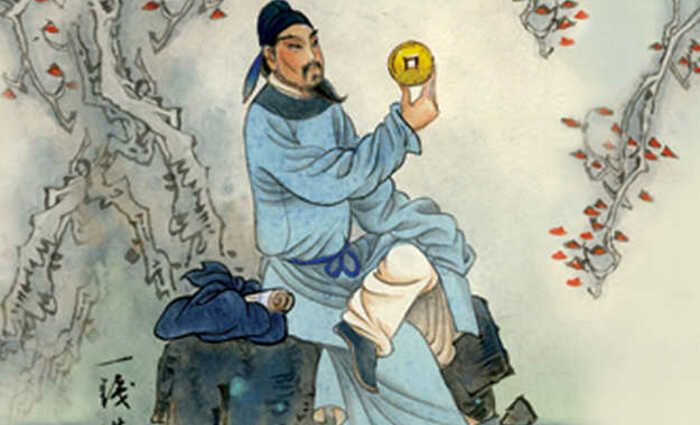
Nowadays, the most common method for casting the I Ching involves tossing three coins six times to create the six-line pattern, or hexagram. A traditional technique for deriving a hexagram, dating from about 500 B.C., involves a fairly complicated process of selecting and sorting fifty sticks, usually yarrow stalks. The best yarrow stalks for this were the ones that grew on Confucius' grave, but the supply was limited! After the coins or stalks are tossed and sorted out, one looks up the interpretation in the sacred book.
Learn more about this ancient oracle by getting your own FREE I Ching Reading now »